TEMPLE OF HEAVEN – A MUST-SEE IN BEIJING
This post may contain affiliate links, which means I earn a small commission — at no extra cost to you — if you make a booking or purchase through them. I only recommend services and products that I personally use, trust, or believe will benefit you. Thank you!
Temple of Heaven is one of Beijing’s most famous sights. But while the main temple itself was somewhat familiar to me I didn’t actually have much of a clue what else is there to see and do there.
It turns out that Temple of Heaven is one of the best attractions in Beijing as it combines several different highlights: the iconic Temple of Heaven itself, various other palace and temple buildings, as well as a beautiful park with the vibrant public life so distinctive for China.
Read on for a review of my visit with everything you need to know about visiting this great sight!
My Visit to Temple of Heaven
Planning and Ticket
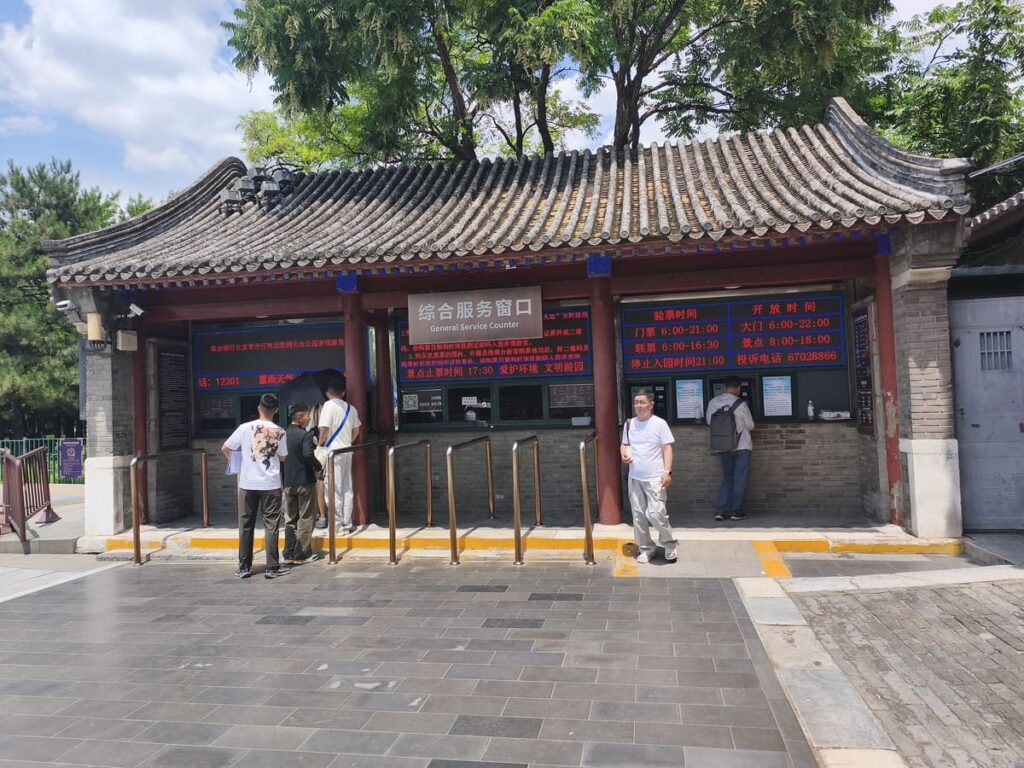
Once again, I prebought my tickets via Trip.com a week or so before my visit. I chose the combo ticket which includes both entry to the park (open daily) and to the temple attractions (closed on Mondays). I am pretty sure you can get at least tickets for the park on the day but am less sure about the actual attraction tickets. Anyway, I didn’t mind potentially paying a little more to avoid disappointment. At USD 7.97 for the combo ticket it didn’t have much impact on my budget.
As with many Beijing attractions, you have to choose between morning and afternoon visit. The time you pick just applies for when you enter the park – you can stay longer. I chose the morning session to beat both crowds and heat.
As is best practice in China, I did take my passport along but don’t think I needed it (unlike at the Forbidden City). I did scan the QR code I received in an email (or in the app). Still, this could change so do take your passport!
Getting to the Temple of Heaven
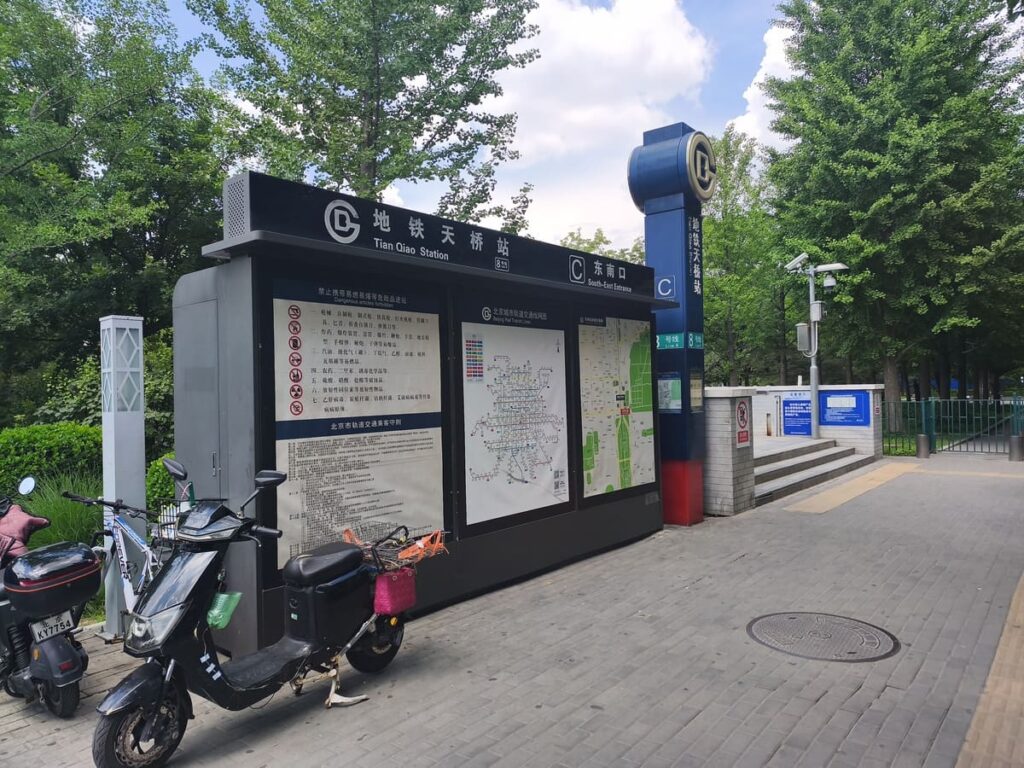
How best to get to Temple of Heaven will of course depend on where you are coming from – either Amap or Baidu Map will show you the easiest/fastest way. Coming from the Wangfujing area I took the Subway to Tian Qiao Station on Line 8 (Exit C). It was a short ride (3-4 stops) with no need to change trains. You can read more info about how to get around Beijing in my post about the city’s public transit.
Temple of Heaven was actually my first major attraction on my first full day in China so I was a bit nervous but it was a lot easier than I expected!
To make your trip to China smoother I recommend you get an international esim (I used this one) so you have data for navigation, payments via Alipay or WeChat, and communication.
Making my Way from the entrance to the Temple
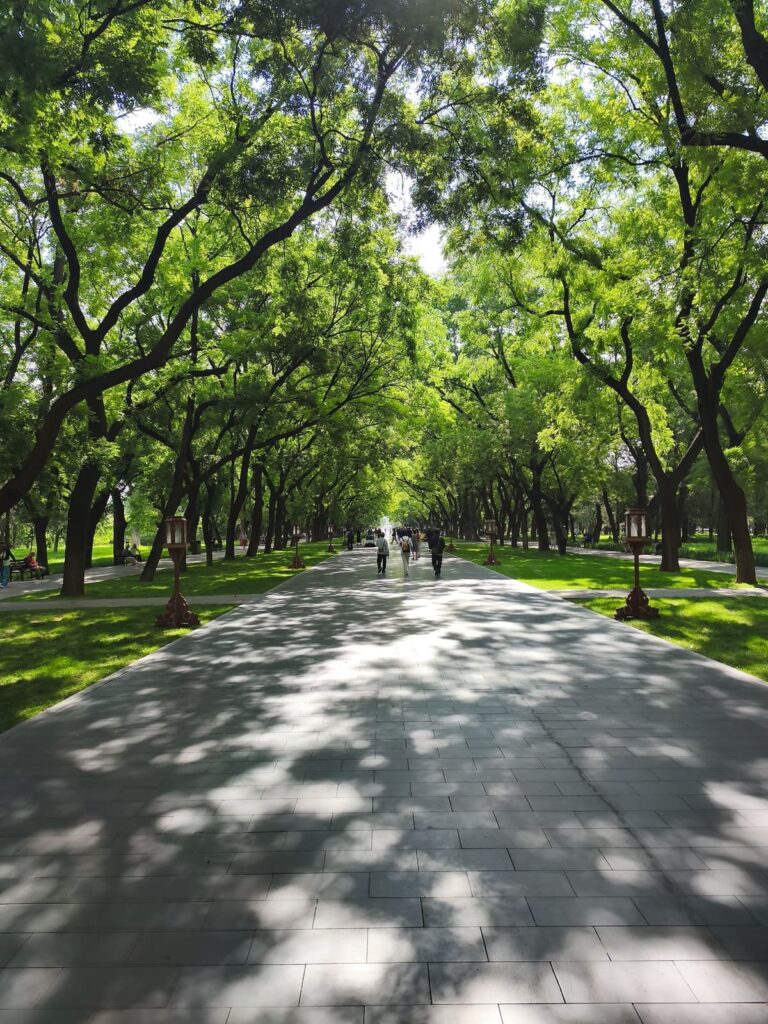
The Park felt surprisingly serene
Once past the ticket gate, I walked along a long, wide path. While there were some tourists as well as locals I was surprised that the overall atmosphere was quite serene and zen. For some reason I had expected Beijing to be rather frenetic (and I am sure it can be in some places) but this was a very peaceful atmosphere.

It was also very clean and in great shape. No broken tiles or dirty pavement here (maybe due to the robots).
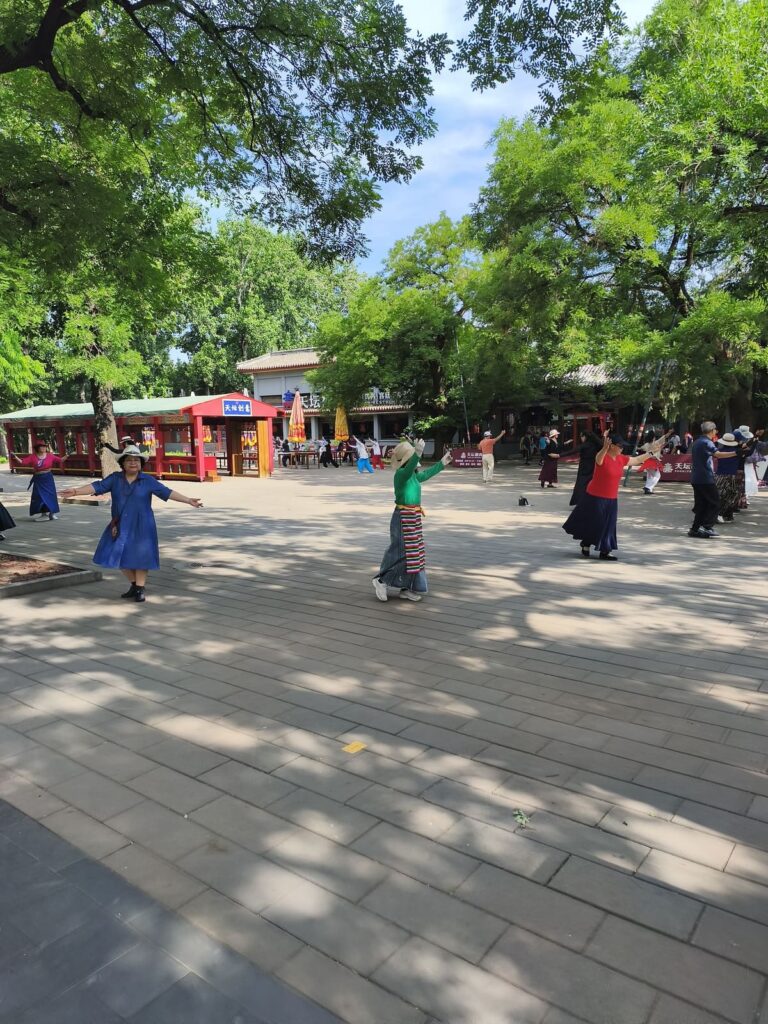
The first thing I really noticed (and absolutely loved) was the vibrant life inside the park. Especially in the mornings many, many locals (often seniors) meet up in the parks to live their best life. I passed old men playing with rackets, balancing balls, or juggling diabolos. There was a lot of line-dancing and tai chi as well as women twirling around ballroom dancing! It made me just so happy to see them all having a great time without worrying about what others might think.
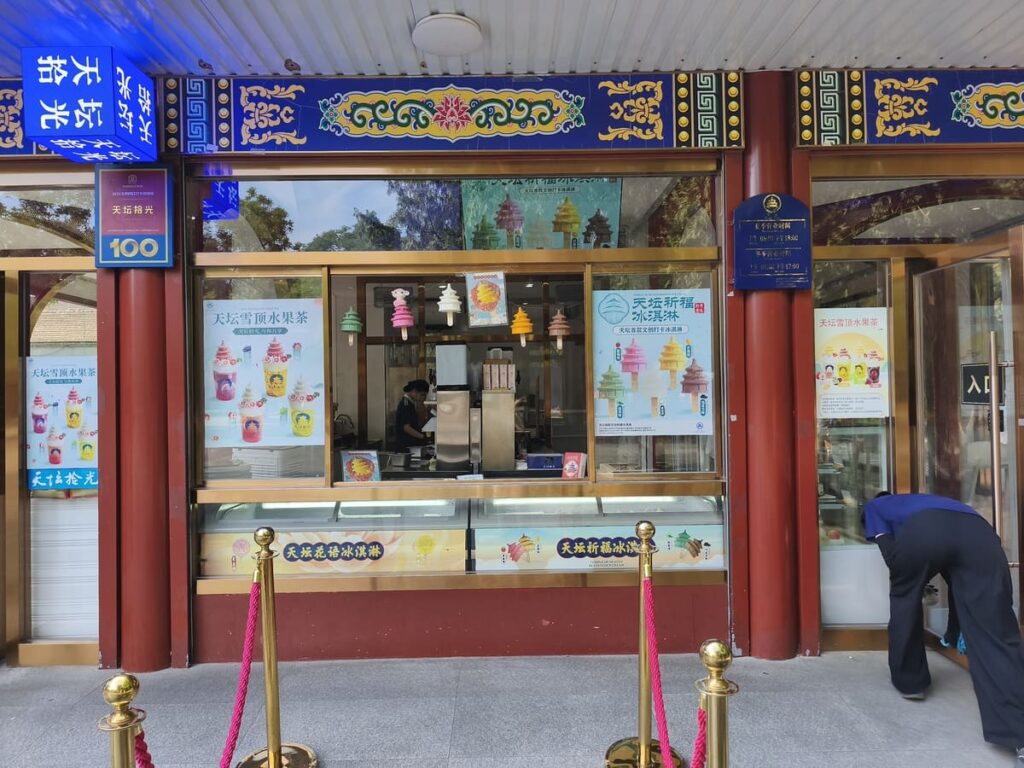
I had skipped breakfast so when I passed an ice cream vending place I couldn’t resist. This was the first of several attraction-shaped ice creams I bought and one of the prettiest! And I was relieved to learn that they did take cash – my Alipay wasn’t quite working yet and I had been worried I would starve!
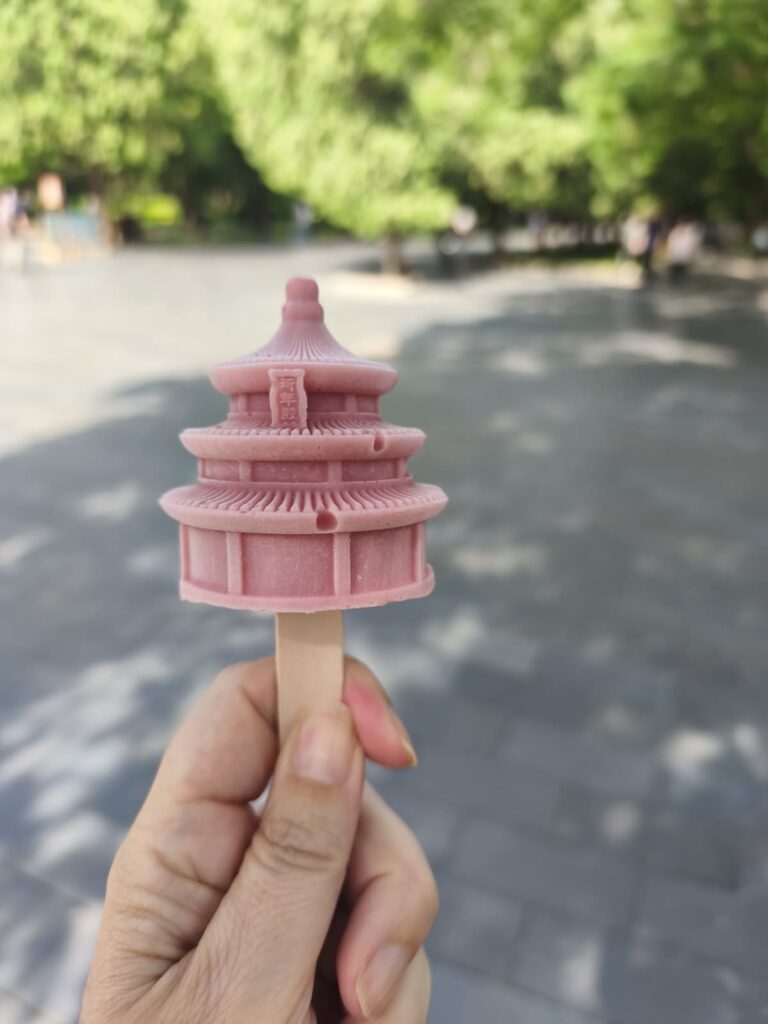
After the ice cream (the taste was a bit bland but I did love the looks of it), I walked on towards the main temple complex.
Visiting the main attractions of Temple of Heaven
Hall of Prayer for Good Harvests
After about 25 minutes I got to the entrance (separate/combo ticket required) to the Hall of Prayer for Good Harvests. This tower-shaped temple was first built in 1420 as a Sacrificial Hall and then changed several times until it got its current name in 1751. Eventually it was used just for ceremonies to pray for good harvests in the first lunar month. Quite an imposing building for someplace that was only used once a year!
Basically you walk across a large rectangular courtyard lined by buildings to both sides with the main hall ahead of you. It is a very impressive sight.
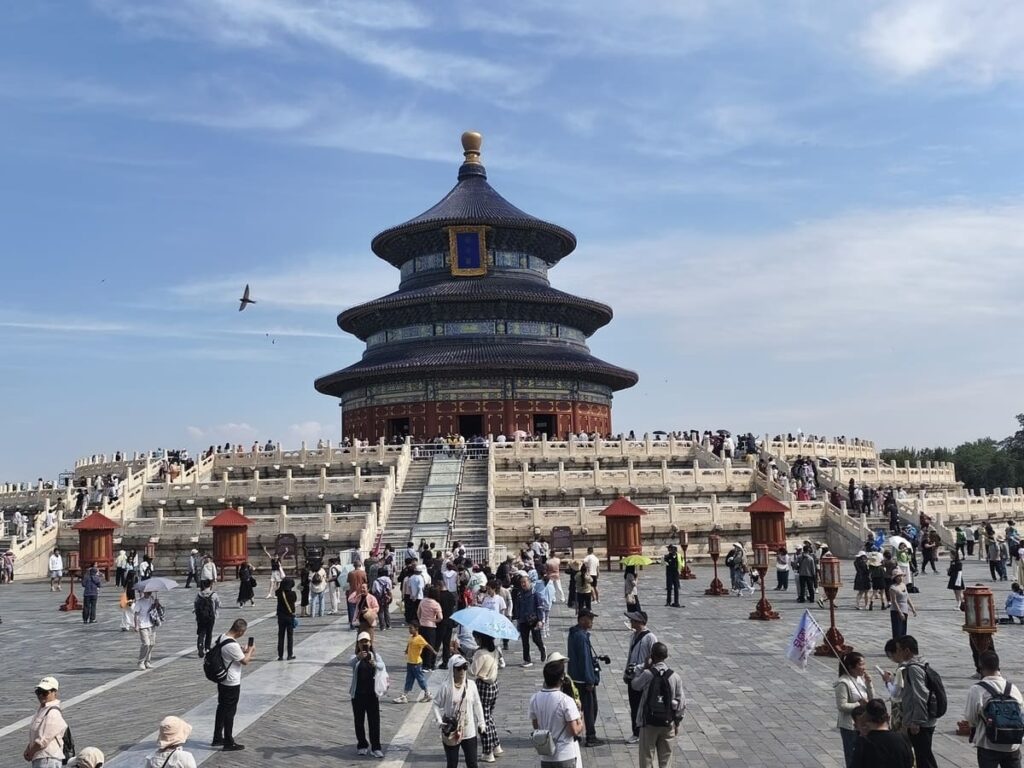
Walking towards the Hall of Good Harvests did feel like being on the set of a C-drama. The swooping swallows made it even more authentic – I could basically imagine the emperor performing the rites and birds flying by as a good (or bad) omen!
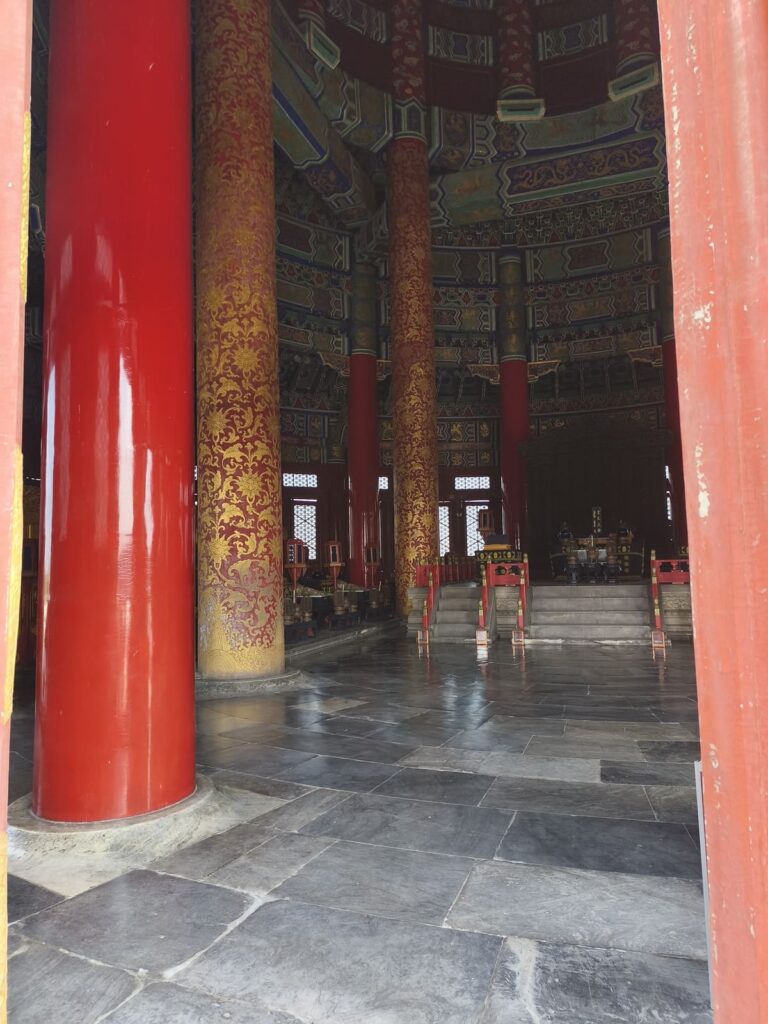
This part of the site was quite busy with – mainly Chinese – tourists. You can look at the inside of the hall but might have to wait (and/or push and shove) a bit.
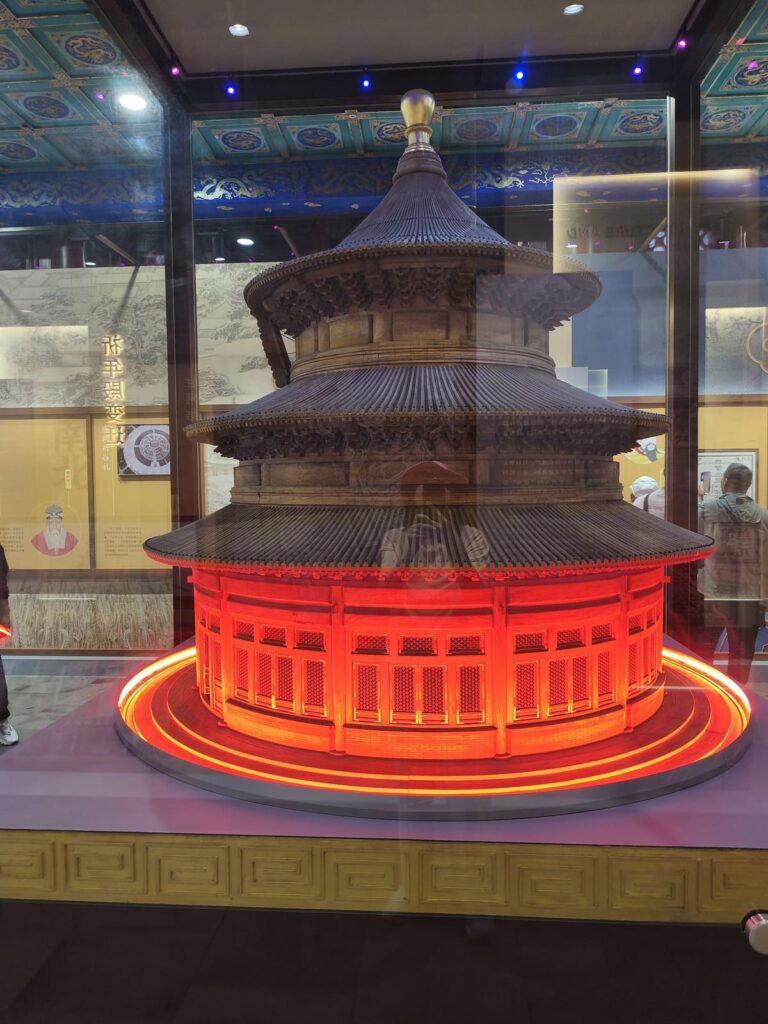
After admiring the main hall I still checked out the buildings to the side. You can visit the Hall of Imperial Zenith (where the spirit tablets of the imperial ancestors were enshrined) as well as an exhibition dedicated to the Hall of Prayer for Good Harvests. I just gave everything a quick glance but did think the temple models and history quite interesting. While general signs on the grounds were bilingual Mandarin/English, the information in the exhibitions was mainly Chinese though.
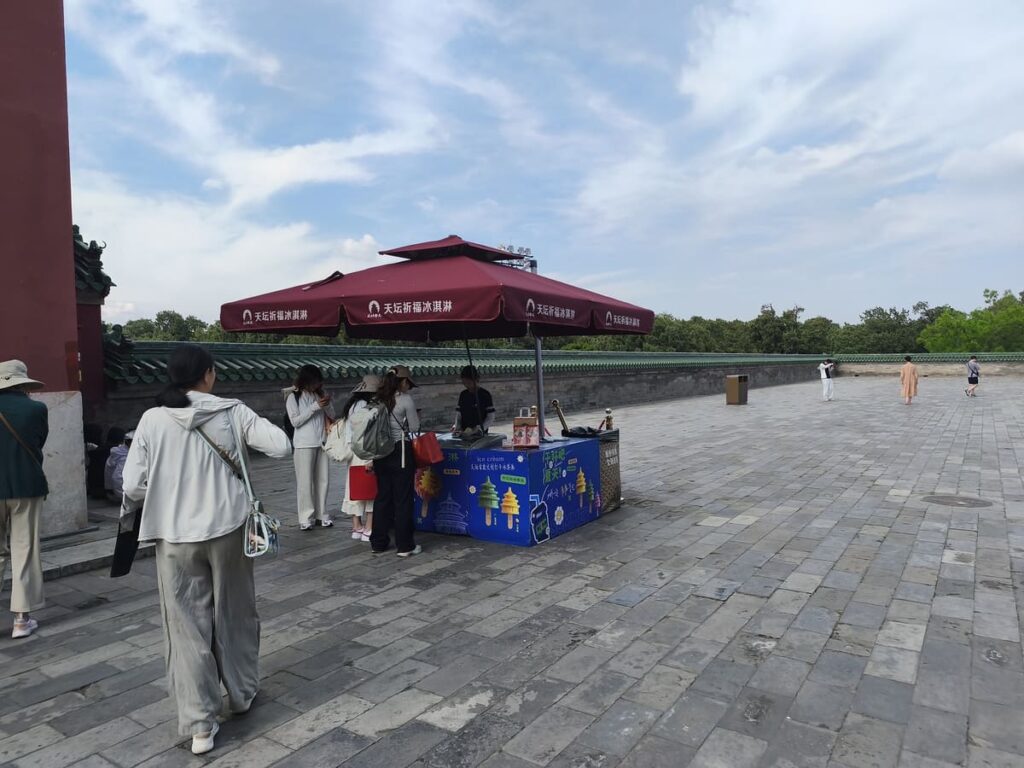
If you missed getting an ice cream earlier they sold them here as well. This would be a better place for a purchase if you want to take a photo of the ice cream with a backdrop of the actual building. I had originally wanted to do this but my ice cream was starting to melt in the heat so I abandoned the idea!
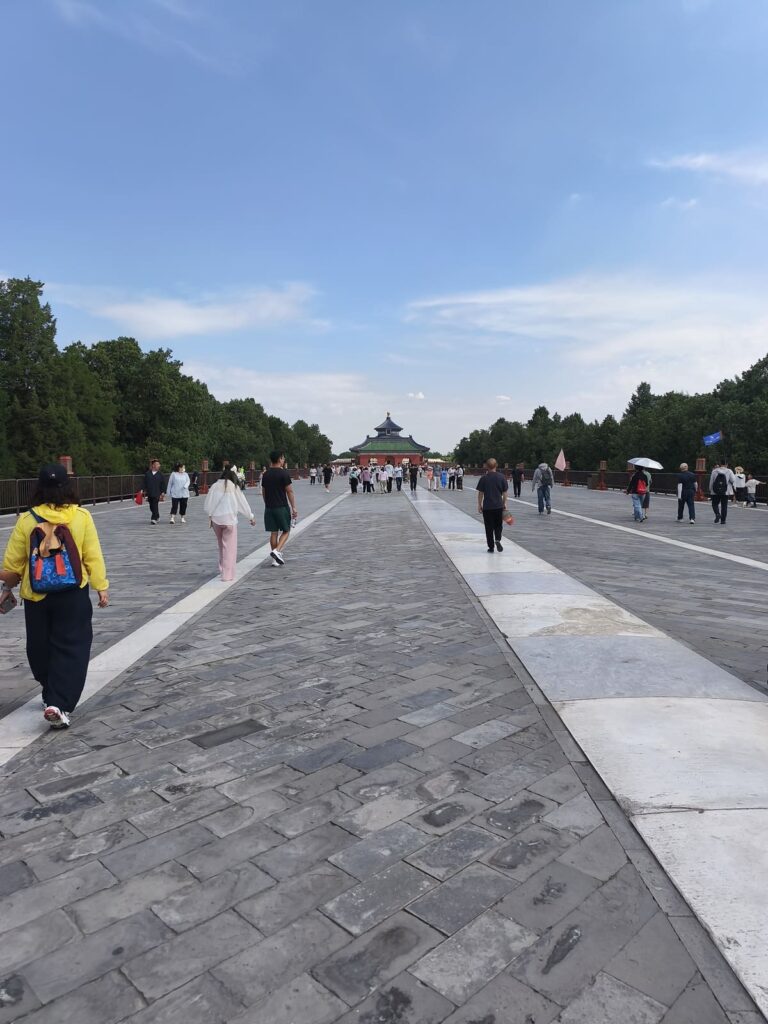
Danbi Bridge
After passing through a reddish/pink gate I got to the Danbi Bridge that connects the Hall of Prayer for Good Harvests with the Circular Mound Altar. It is 360 meters long and 30 meters wide and you can even walk on the Divine Path, the central stone-slab path that was once reserved for the Emperor.
Echo Wall
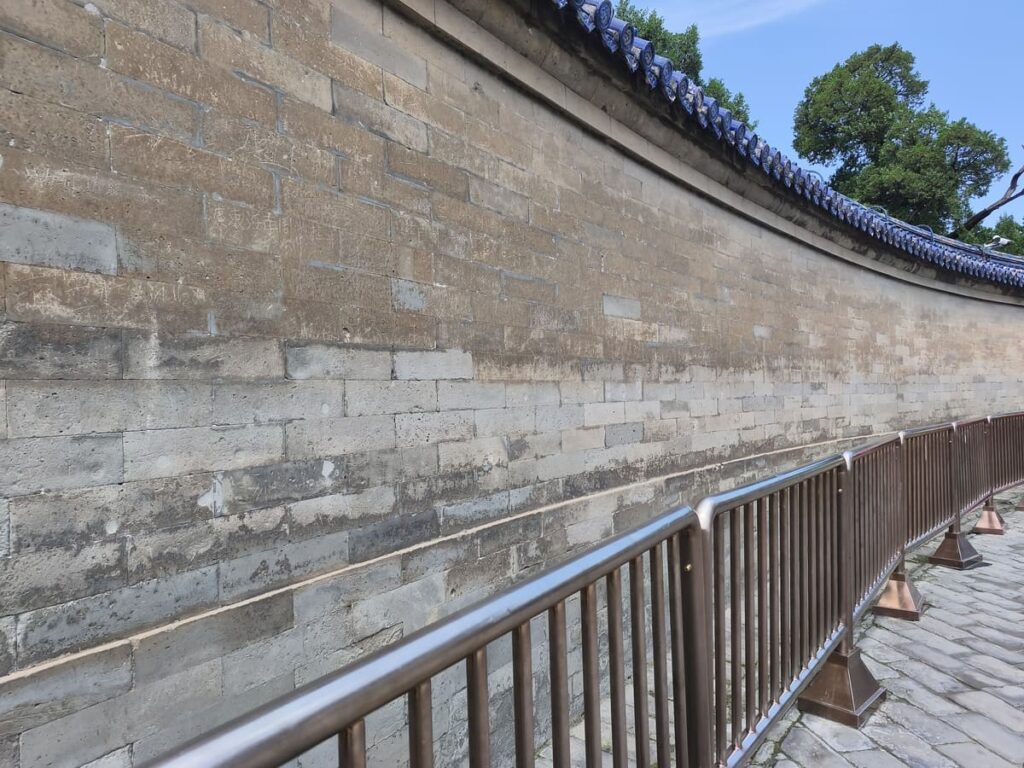
As I walked towards the Imperial Vault of Heaven I noticed the curved stone wall and people looking at it but didn’t think much of it. It wasn’t until later that I realized this is the Echo Wall which supposedly makes it possible to hear what someone is saying at the other side of the plaza. This meant I had to come back to get a picture – unfortunately I couldn’t really test whether the acoustics really work as it would require someone to do it with. But given that it was fairly noisy with all the tourists and that you can’t get very close to the wall due to the railing, I am not sure the experiment would work anyway.
Imperial Vault of Heaven
The next sight, at the other end of the Danbi Bridge from the Hall of Prayer of Good Harvests, was the Imperial Vault of Heaven. This building with a conical roof was built in 1530 and was used in the worship of the Emperor and his ancestors during the harvest ceremonies.
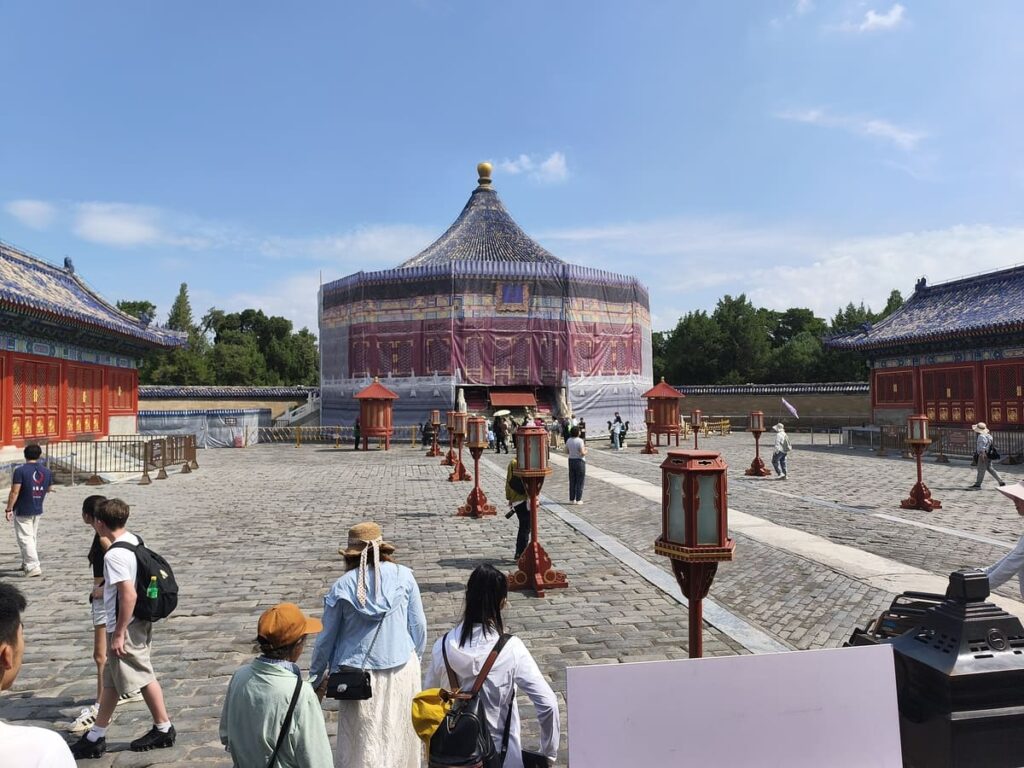
Unfortunately, the building was under renovation during my visit. As always it is a bit of a let down if important structures are covered with planks and tarps. But pretty much any time you go sightseeing something will be under construction – at least it wasn’t the Hall of Prayer for Good Harvests itself.
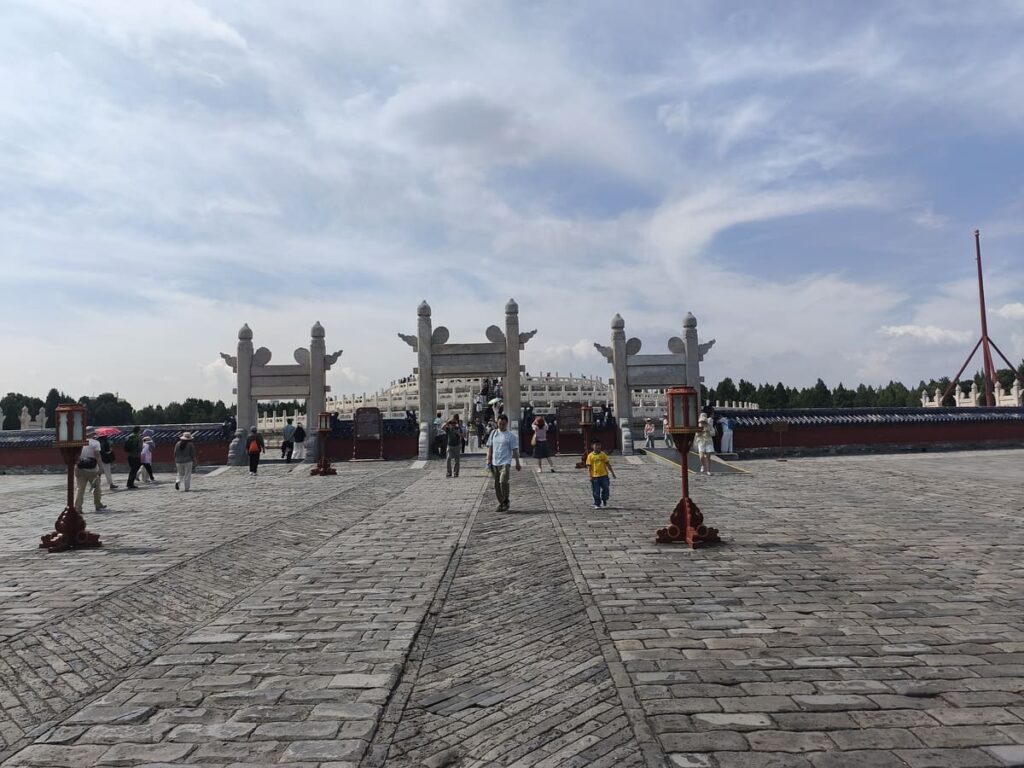
Circular Mound Altar
Next up was the Circular Mound. On this altar the Heaven-worship ceremonies were held on the winter solstice. Basically it is (as the name implies) a circular mound in various steps.
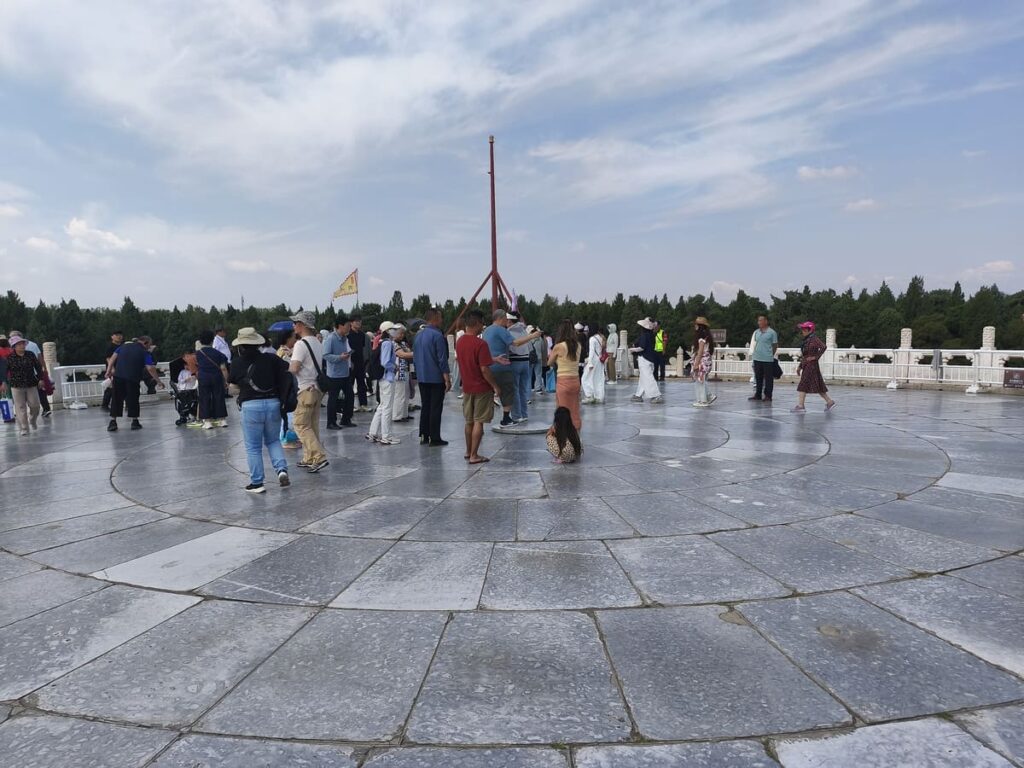
It doesn’t sound that special but actually was quite impressive. When standing in the middle (if only for a second as there is a long line) you do feel like an emperor (or empress). It is especially interesting for anyone who likes numbers/math as the number of steps, the slabs, tiers, and sizes are all based on “heavenly” numbers (which are apparently 1, 3, 5, 7, and 9).
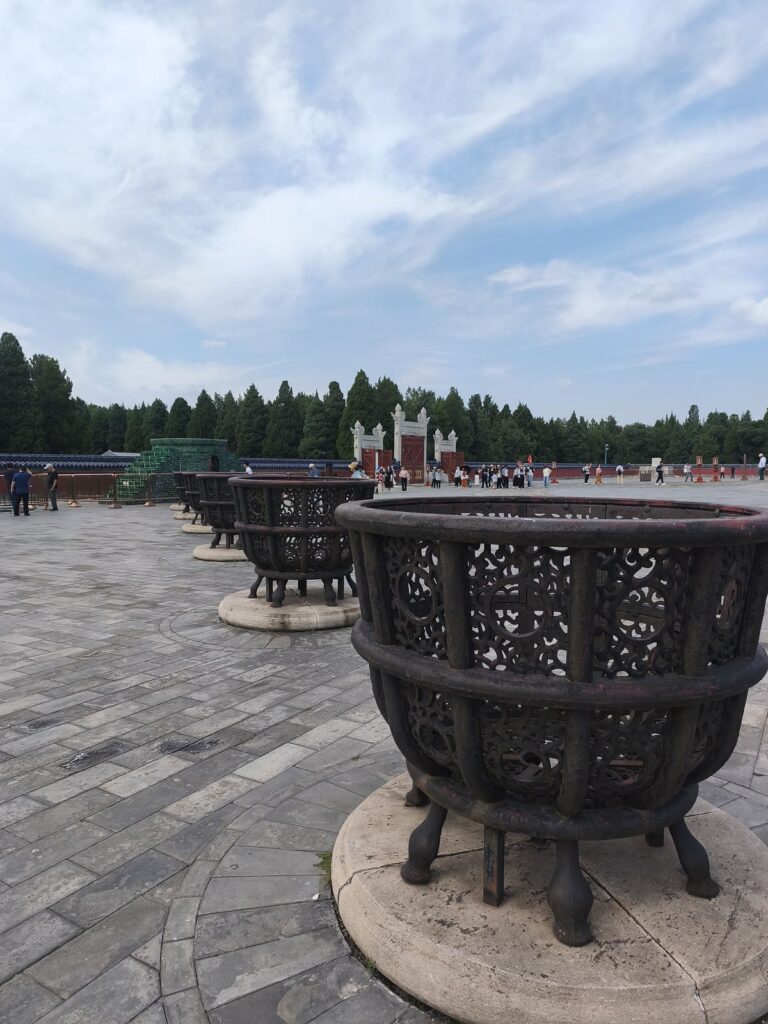
During my time in Beijing I saw several somewhat similar altars (e.g. the Temple of the Sun at Ritan Park) but this was by far the most exciting. Nearby are various burners in which offerings, like prayer tablets and silk, were burned during ceremonies.
Exploring the Western Side of the Park
After seeing these main sights I went to the other (Western) side of the Danbi Bridge and just kind of followed the various signs to most of the other park attractions. I didn’t really plan this ahead of time or anything so while I think I saw most I may well have missed something.
Marriage Market
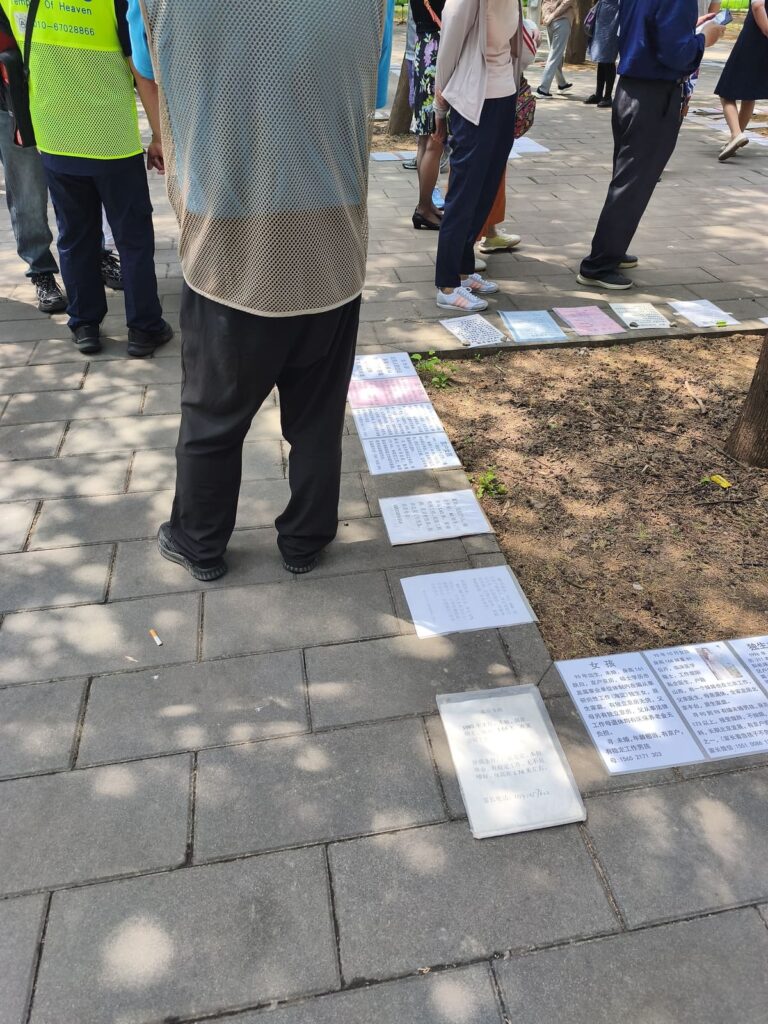
As I was exploring the park I noticed a crowded area. The paths were just full of mostly older Chinese so I went by to see what attraction they were looking at. Turns out it was a marriage market!
I had heard about these marriage markets – an old-fashioned version of dating apps – before but had not made any plans to check one out. But as I just happened to stumble across this one I did of course take a closer look!
Basically, people had printed out short bios of their children (most born in the late 1980s or early nineties) with birth date, education, weight, looks etc. and taped them to the ground. Then they walked around, reading the description of other young people, looking for a good match…
Definitely something I have never seen like this in the US or Europe! I wonder how successful this is in really finding someone for your kids?
7 Star Stones
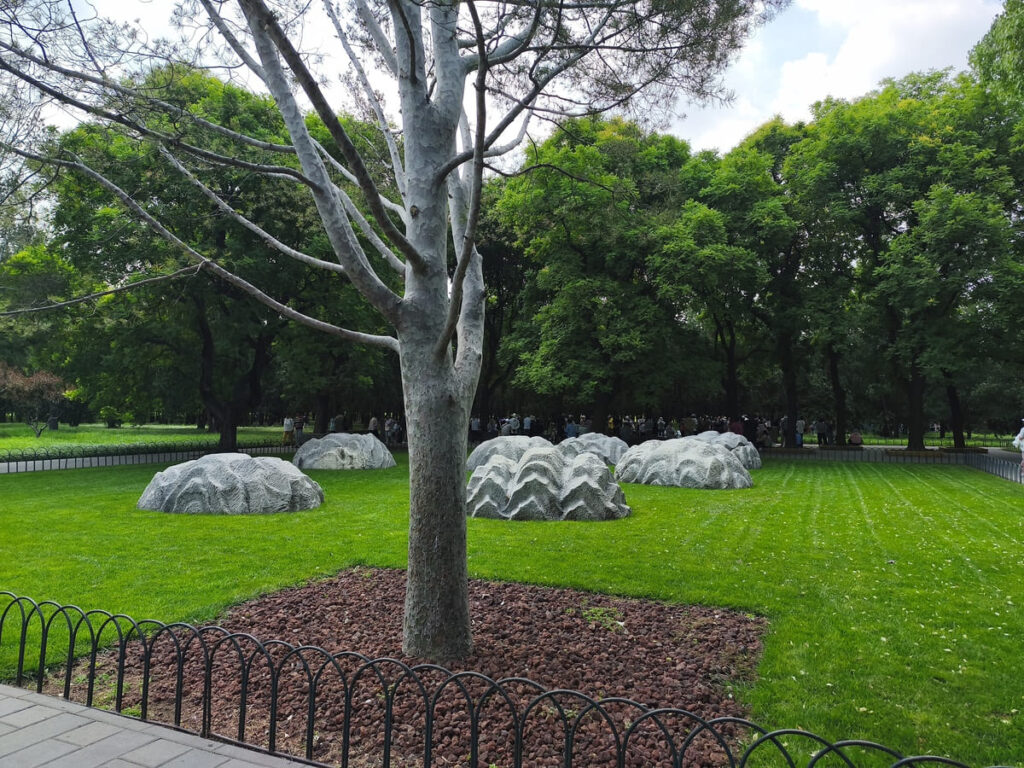
Nearby were the Seven-Star Stones, large stones carved with mountain patterns that represent the peaks of Mount Tai in Shandong.
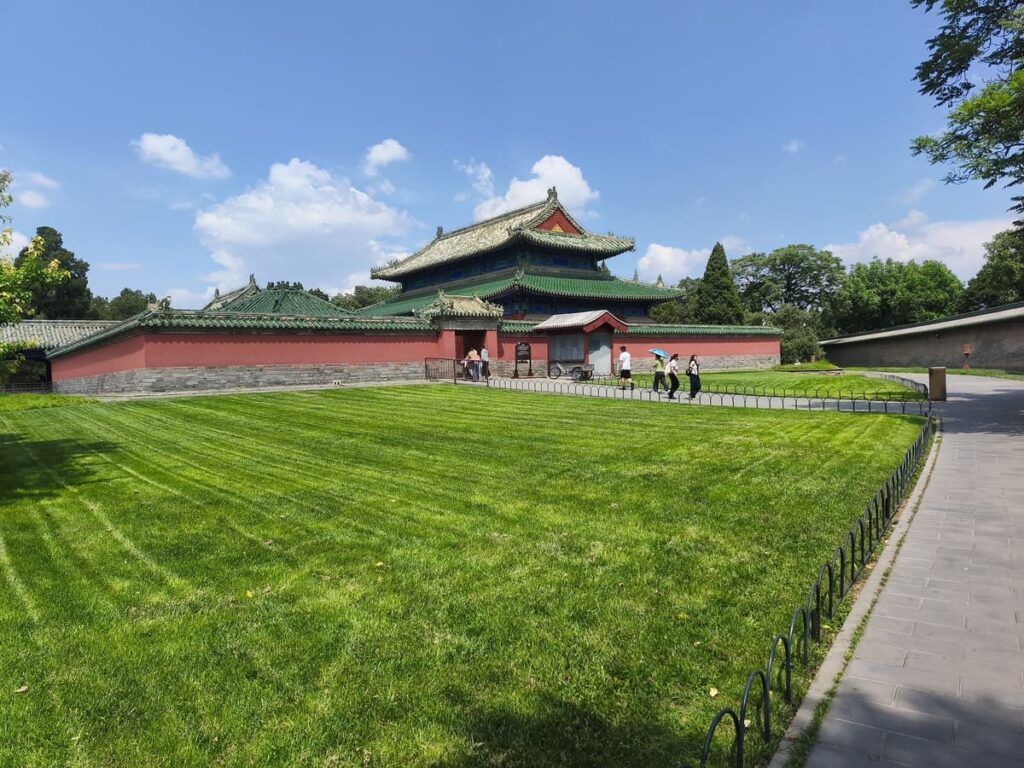
Animal Sacrifice Pavilion
Okay, this does sound a bit grisly – and presumably was – as animals for sacrifices were slaughtered here. But the inside looks quite harmless now and the outside well was interesting.
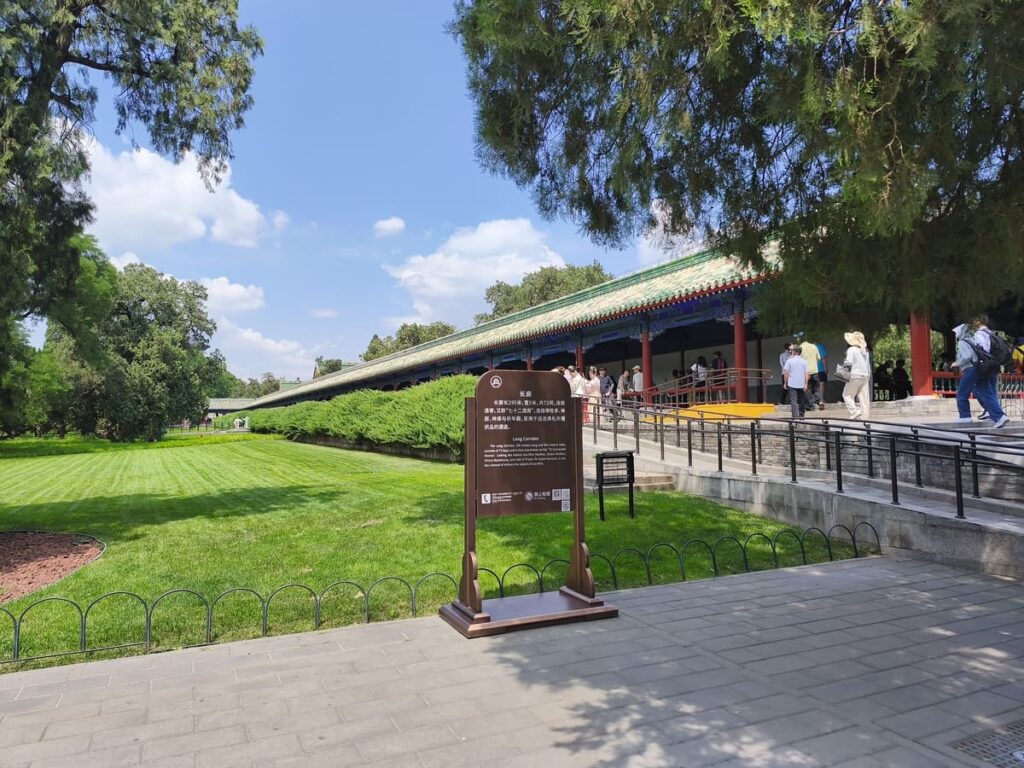
Long Corridor
The Long Corridor connected the Animal Sacrifice Pavilion with the Divine Kitchen, the Divine Warehouse and the Hall of Prayer for Good Harvests and basically was the delivery path for sacrifices.
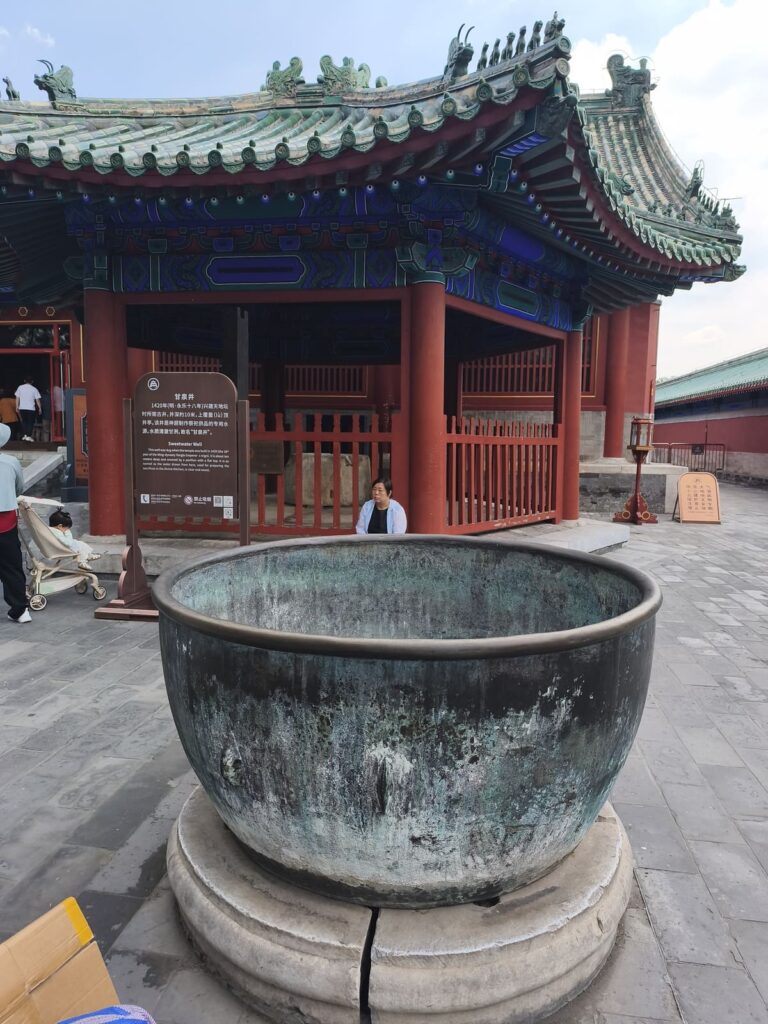
Divine Kitchen
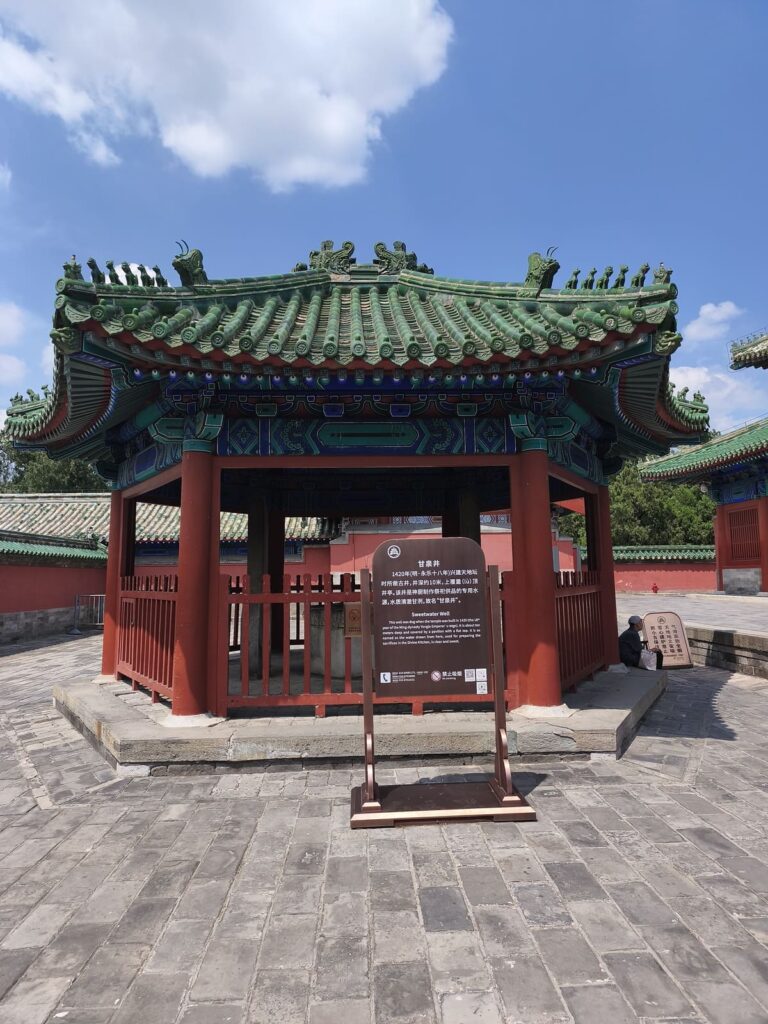
This is where the sacrificial items were handled (as per the official sign). I presume they cooked the sacrificial animals and other offerings here.
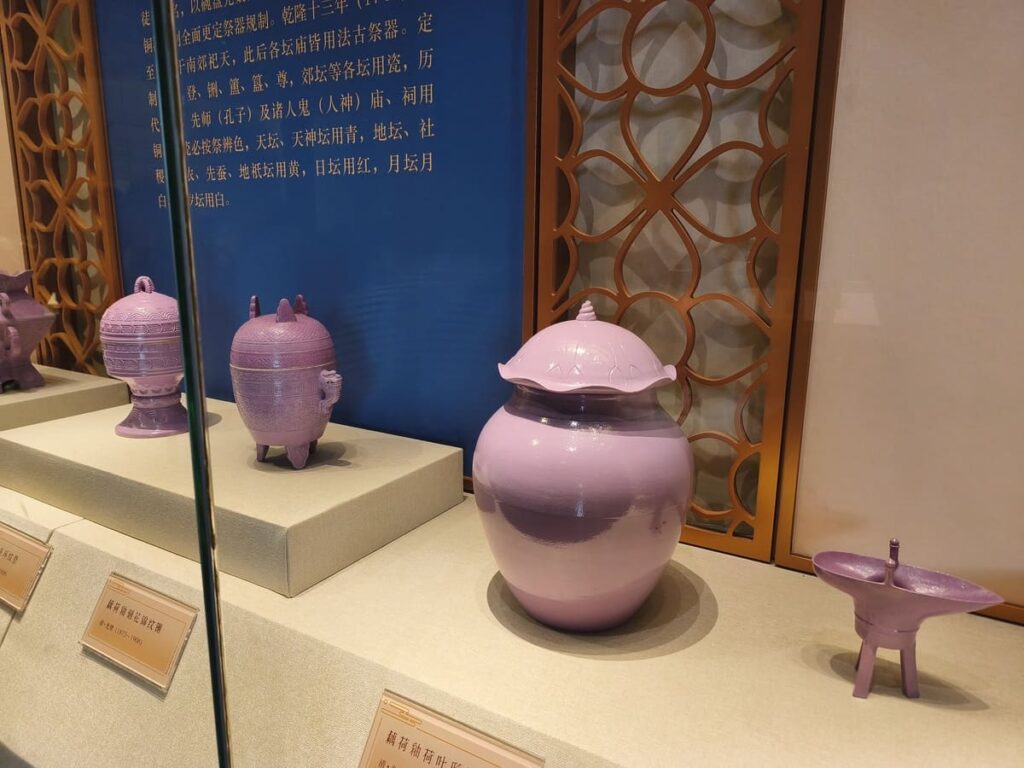
Inside the buildings here was a small museum with archeological artefacts, pottery, kitchen equipment, and other odds and ends. I was quite happy to see all of these as I had already realized that I would probably not manage to visit the National Museum so at least I got to see some cultural objects.
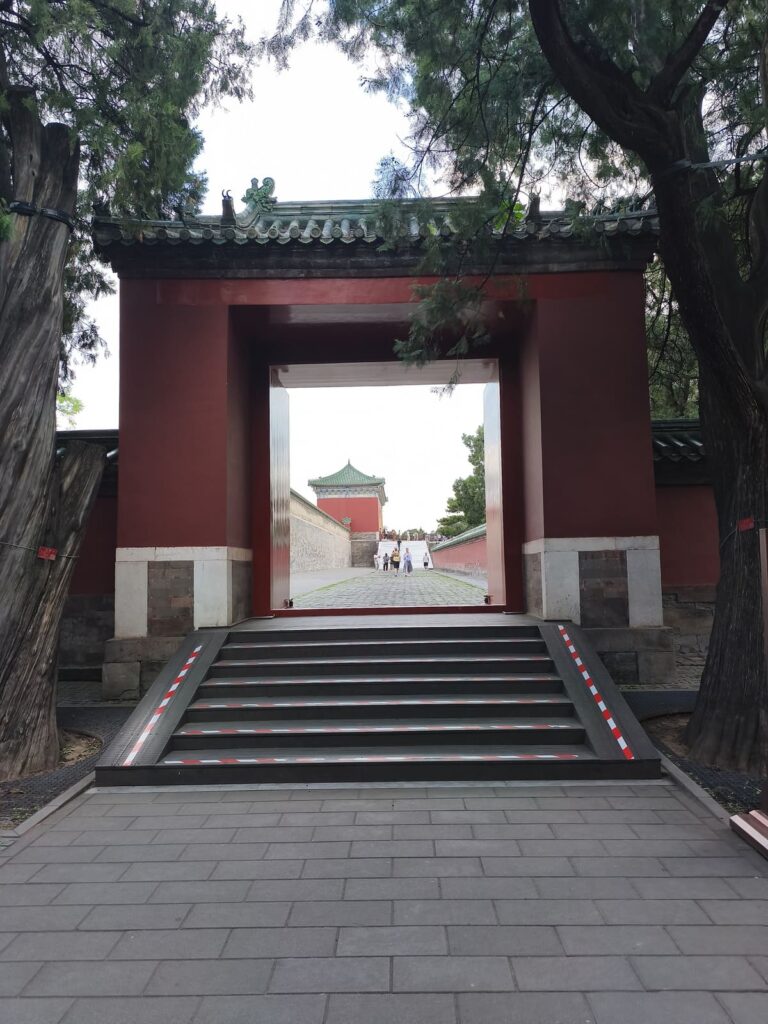
Gate of the Sexagenarian
By this time I had pretty much covered the area to the West of the Danbi Bridge as well as to the North of the Hall of Prayer for Good Harvests and was making my way slowly back towards the entrance. On the way I passed the Gate of the Sexagenarian, a side gate for the emperor so he didn’t have to walk as far for the ceremonies once he was over 60 years old.
Exploring the rest of the Gardens on the way out
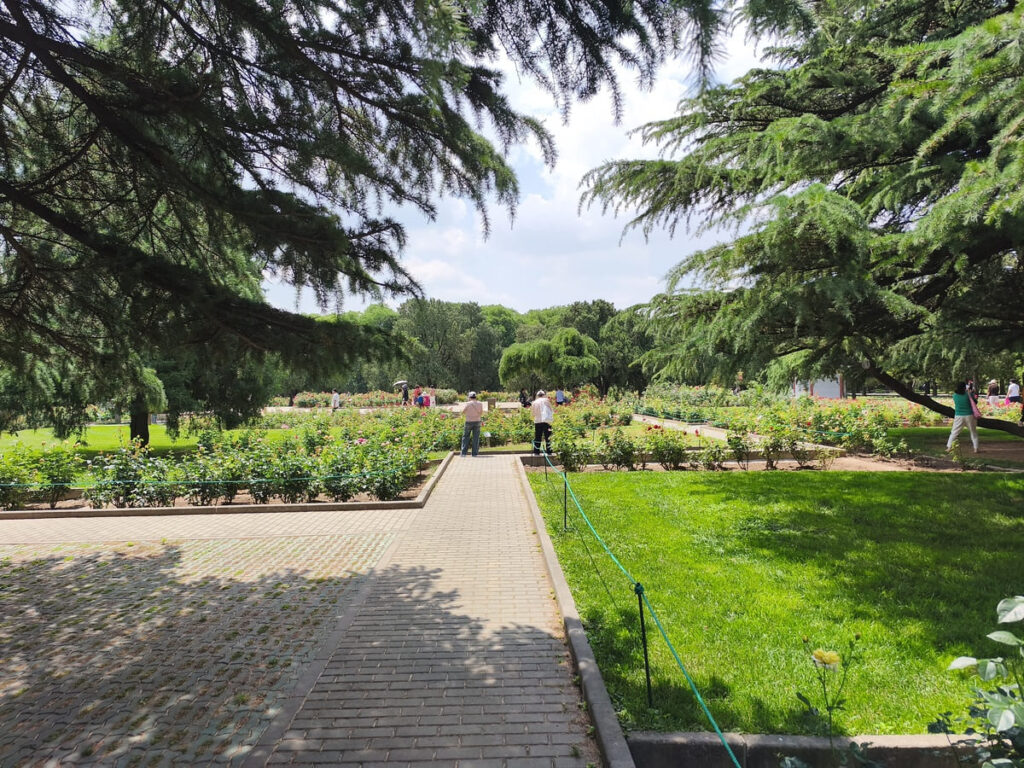
Gardens and flowers
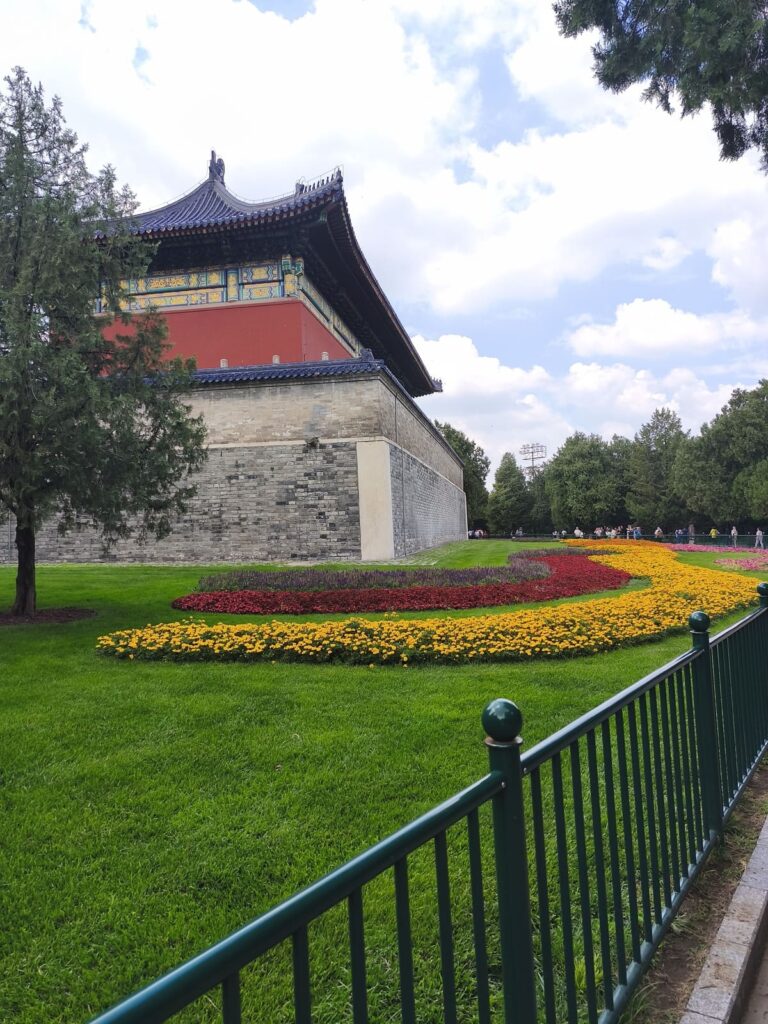
On my slow stroll back towards the entrance I explored the pretty gardens, including a rose garden and a cute little pavilion.
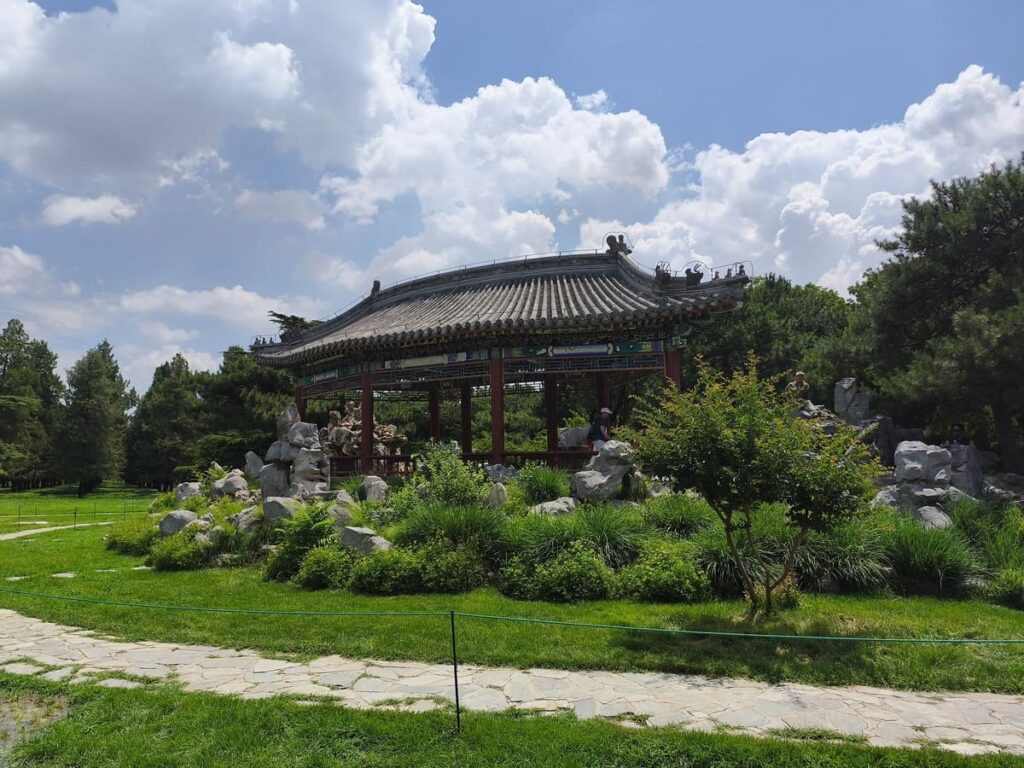
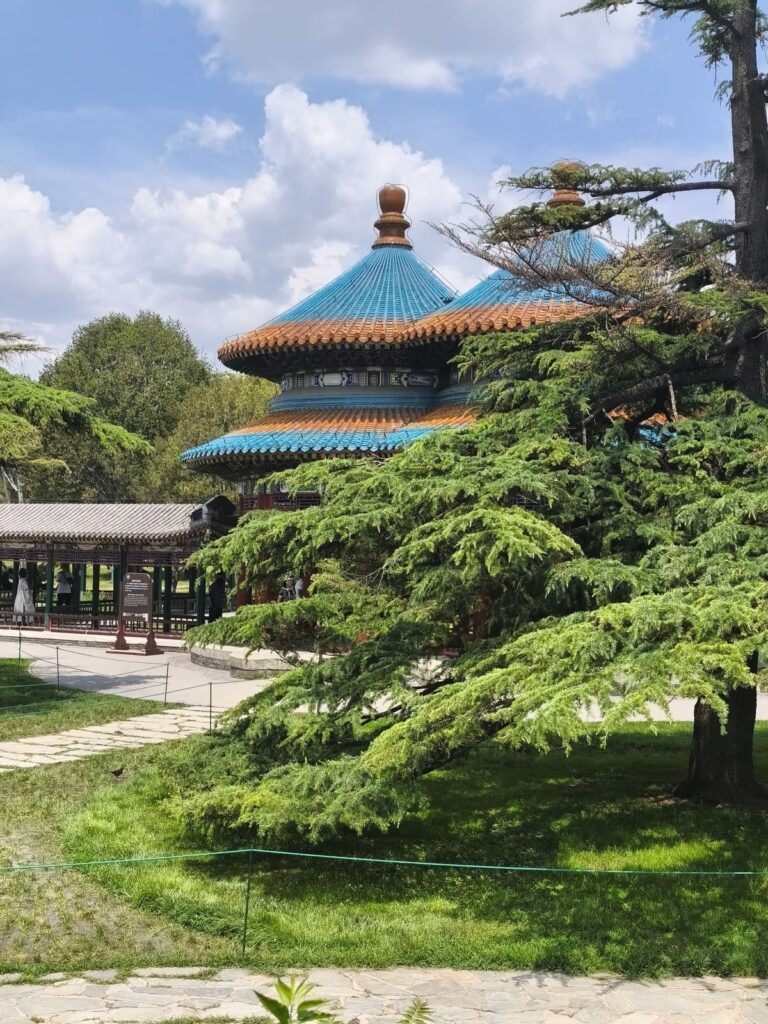
Fangsheng, Fan-Shaped, and Double-Ring Pavilion
My last stop was a collection of several pretty pavilions set in beautiful gardens. These buildings on their own would be worth a visit to Temple of Heaven. I spent a little time just sitting there, enjoying the pretty views, but eventually made my way out of the park and back to my hotel.
Is Temple of Heaven worth a visit?
Absolutely, Temple of Heaven is one of Beijing’s most famous sights and should not be missed. Consequently, it is also part of my recommended three-day itinerary for China’s capital.
Not only are the main sites there some of the most impressive and majestic but a visit combines history and architecture with nature and a glimpse of daily life in China. An absolute must-see!
Should you book a tour?
As you can see from my post it is quite easy to explore Temple of Heaven on your own. The logistics are simple and I felt there was a fair amount of information provided on signs throughout the site.
However, if you prefer more detailed explanations, a guided tour (this one seems interesting) may be a good option. In addition, I would recommend a guided tour if your time is short and you want to combine several major attractions in one day (e.g. combine Temple of Heaven with the Palace Museum) as it will help you to see the most important parts in the shortest time with the least amount of hassle.
How much time to visit Temple of Heaven?
If you are in a big hurry you can probably get to the main sights and check them out in about an hour. However, if you want to see some of the minor sights and enjoy the park atmosphere I would calculate at least 2-3 hours.
It took me a good 3.5 hours to pretty much visit all the major and minor attractions at a leisurely pace. If you have only a short time in Beijing you could definitely visit Temple of Heaven without spending quite that long though.
Conclusion
Temple of Heaven is definitely one of the best things to see in Beijing. While the main attractions can get crowded, the park itself is big and has a very serene atmosphere.
I especially enjoyed the mix of impressive historical sights, beautiful buildings and exhibits, gorgeous gardens, and lively park culture. I would recommend a visit even if you are only in town for a very short time as it will cover much of what you would want to experience in Beijing.
The park is big and a visit can be tiring but it is less exhausting than for example the Forbidden City. In addition, you can easily adjust this visit to the amount of time you have by either focusing just on the main sights or spending more time checking out all the minor buildings and exhibits.